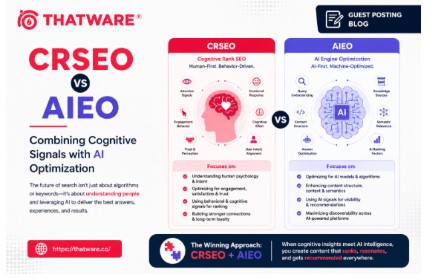
Two acronyms walk into a digital strategy meeting. Neither one is leaving without a heated debate.
AIEO — AI Engine Optimization — has become the topic du jour in SEO circles, sparked by the dramatic rise of AI-generated search results, generative answer engines, and the general anxiety about what happens to organic search traffic when Google just answers the question itself. CRSEO — Cognitive Resonance SEO — takes a different angle, focusing on what happens in the human brain during the search experience.
The good news: these aren’t competing frameworks. They’re complementary. But understanding how they fit together requires knowing what each one actually does.
What AIEO Is (and Isn’t)
AIEO is about optimizing content to appear in AI-generated answers — the featured snippet zone on steroids. As search engines increasingly synthesize answers from multiple sources rather than just listing links, the question becomes: how do you get your content cited, quoted, or surfaced by these AI systems?
The answers tend to involve structured data, clear factual claims, authoritative sourcing, question-and-answer formatting, and entity-based content signals. It’s optimizing for machine comprehension — making it easy for an AI system to extract and use your content.
This is genuinely important. Ignoring AIEO in 2026 means leaving a significant and growing traffic channel on the table.
But AIEO has a blind spot. It optimizes for extraction — getting your content cited — without necessarily optimizing for what happens after the citation. If a user clicks through from an AI summary to your page, AIEO has done its job. What happens next is a different problem.
CRSEO vs AIEO services distinctions matter precisely at this junction: the click-through experience, the landing, the psychological moment when a real human decides whether to engage or bounce.
How CRSEO Fills the Gap
Here’s where CRSEO earns its place alongside AIEO.
A user who arrives from an AI-generated answer is often in a specific psychological state. They’ve already gotten a summary — they came to your page for depth, context, or a specific next step. They’re not starting from scratch. They’re arriving with partial information and a specific question still lingering.
CRSEO-informed pages are designed for exactly this kind of arrival. The content doesn’t re-explain what the AI already told them. It acknowledges the context and moves immediately to the value that only the full page can provide. It meets the reader where they are psychologically, not where a default content template assumes they are.
This is the difference between a page that gets cited by an AI and a page that converts the visitor the AI sends over.
Human centric SEO services bring the psychological layer that AIEO, by design, doesn’t address. AIEO gets you seen. CRSEO makes you matter once you’re seen.
The Practical Integration
Running both frameworks in parallel isn’t as complicated as it might sound. They operate on different layers of the same content.
The AIEO layer focuses on structural signals — clear headings, schema markup, factual density, entity recognition, direct answers to likely questions. These are largely technical and structural decisions.
The CRSEO layer focuses on psychological signals — emotional framing, cognitive load management, trust building, objection handling, decision architecture. These are content and experience decisions.
They don’t conflict. They stack. A page can be both structurally optimized for AI extraction and psychologically optimized for human conversion.
The key is sequencing the work correctly. Start with the AIEO architecture — the structural bones of the content. Then layer the CRSEO work on top: the emotional framing of introductions, the psychological sequencing of information, the trust signals positioned at the right moments in the reader’s journey.